2026-10-28 · Teguh
Protecting Kitchen Cabinets During Arizona Monsoon Season
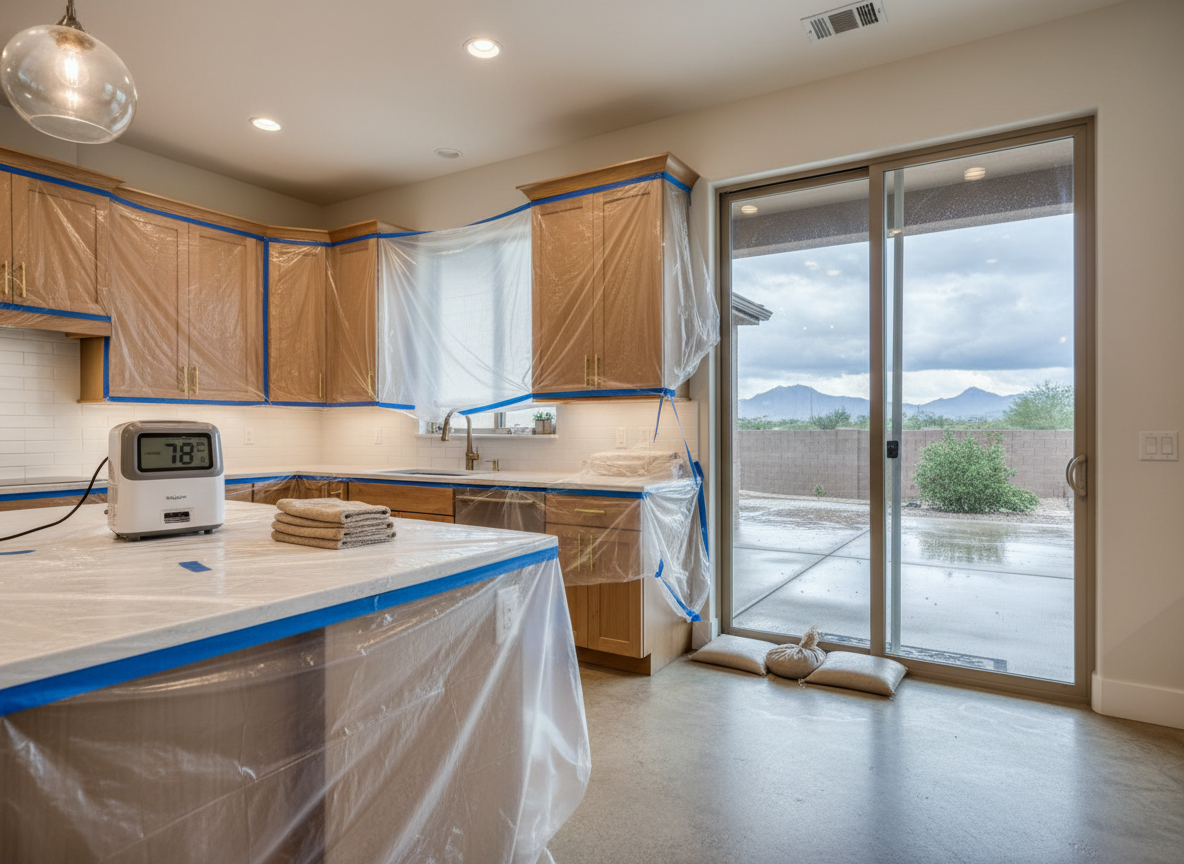
Yes, Arizona monsoon season really can damage your kitchen cabinets — but not the way most homeowners expect. From roughly June 15 through September 30, dew points in Maricopa County jump from the teens into the 60s, and indoor relative humidity that sat in the low 20s all spring can spike past 40–50% almost overnight. That swing is enough to make solid-wood doors and drawer fronts expand by a measurable fraction of an inch, which shows up as doors that suddenly won't close flat, stiles rubbing in the middle, and visible gaps that weren't there in May. The damage is usually reversible if you respond quickly, but a full season of ignored swelling can crack finish joints and permanently warp thin panels. Here's what I tell every Chandler client before the first big storm rolls up from Tucson.
Why Monsoon Season Hits Cabinets Harder Here Than Anywhere Else
The problem isn't the humidity itself — it's the swing. In Phoenix, Tempe, and Mesa, our desert air normally sits so dry that wood slowly loses moisture all year. Cabinet doors built and finished in that environment stabilize at a low moisture content. When monsoon moisture arrives, the wood drinks it back in, expanding across the grain. Then October arrives, the humidity crashes back to 20%, and the wood shrinks again. That repeated cycle stresses joinery and finish far more than a consistently humid climate like the Southeast ever would.
Housing stock matters too. In Downtown Chandler and older pockets near the Chandler Center for the Arts, many kitchens date from the 1970s–1990s, with face-frame cabinets and solid wood doors that were finished before modern catalyzed coatings. Those older finishes have hairline cracks at panel edges where humid air enters. Newer builds in Ocotillo and Chandler Heights often use engineered panels that move less, but their thermofoil and painted finishes have their own monsoon vulnerability: trapped moisture behind doors under sinks. If you're planning new cabinets before the season hits, our custom kitchen cabinet design process accounts for Arizona's humidity swings from the start.
The 5 Signs of Monsoon Damage to Check After Every Storm
Walk your kitchen after each significant storm system and look for these in order of severity:
- Doors no longer sitting flat against the face frame — the classic first sign of cross-grain expansion.
- Sticking or rubbing where two door stiles meet in the middle of a cabinet run.
- Finish clouding or whitening on surfaces near the sink, dishwasher, or range — moisture trapped under the coating.
- Musty odor inside base cabinets, especially under the sink where a slow supply-line drip plus monsoon humidity compounds.
- Hairline cracks at joints on painted doors — this is permanent and means the door cycled too far.
Catching items 1 and 2 early usually costs you nothing but a screwdriver adjustment. Item 3 sometimes buffs out. Items 4 and 5 need real intervention, and item 4 in particular is worth a plumbing check, because moisture plus our heat is how mold gets established inside cabinet boxes in Sun Lakes and other 55+ communities where kitchens see less daily airflow.
Practical Protection: What Actually Works in a Chandler Kitchen
Start with airflow, not product. Run your range hood and use the dishwasher's delay cycle so it isn't dumping steam into the kitchen during the most humid evening hours. If you have an HVAC system with a dehumidification setting, use it — holding indoor humidity under 40% during July and August prevents most of the swelling cycle. Ceiling fans and open cabinet doors in unused corners (that butler's pantry you never enter) keep stagnant humid air from settling inside boxes.
For the cabinets themselves:
- Wipe down door fronts and frames with a barely damp cloth after heavy cooking or dishwashing sessions — dried-on moisture film is what dulls finishes.
- Check under every sink monthly from June through September; a $10 supply-line drip can destroy a $2,000 base cabinet run.
- Re-caulk the backsplash-to-counter joint before monsoon season if it's cracked — that gap is a direct moisture channel into the cabinet top rail.
- Adjust hinges mid-season rather than forcing doors closed — forcing a swollen door bends hinges and cracks finish at the screw holes.
If your doors are already tired and the monsoon cycle keeps exposing finish failures every year, cabinet refacing with modern finishes often costs a fraction of replacement and gives you a fresh, better-sealed surface going into the season.
Material and Finish Choices That Survive the Monsoon Cycle
If you're building or rebuilding, material selection is your best long-term protection. HDF-center doors and engineered panels move roughly half as much as solid wood across the grain, which is why I steer most Chandler clients toward them for wide sink-base and pantry doors. Where solid wood is wanted — and plenty of homeowners in Ocotillo's larger homes want it — quarter-sawn or rift-cut lumber moves less than flat-sawn, and a conversion-varnish or catalyzed finish seals panel edges far better than the lacquers used decades ago.
Construction details matter as much as materials: floating panels need adequate expansion room, drawer boxes benefit from dovetailed joinery that flexes rather than opening, and every cut edge — including the ones nobody sees inside the box — should be sealed. Unsealed interior edges are exactly where monsoon humidity enters and where I most often find swollen particleboard during tear-outs. For more on getting dimensions right before you build, see our guide on measuring for custom kitchen cabinets in Chandler homes, and if you're weighing budget trade-offs, our breakdown of what influences custom cabinet pricing in Chandler covers where finish quality is worth spending.
After the Season: The October Inspection
Once monsoon season ends and the air dries out, do one final pass in mid-October. Most doors that swelled in August will have shrunk back — re-adjust hinges now while the wood is at its smallest, and they'll stay true through winter. Tighten any loose screws with a longer screw rather than re-driving the same hole, check that drawer glides still run smooth, and touch up any finish chips before winter's dry air widens them. Sun exposure through west-facing windows is the next seasonal threat — our guide on selecting finishes for Chandler kitchens exposed to sunlight picks up where monsoon protection leaves off.
Chandler Custom Cabinets by Teguh is locally owned and owner-operated, and you can reach us Mon–Fri 8am–6pm and Sat 9am–2pm for cabinet work anywhere from Downtown Chandler to Sun Lakes and Chandler Heights.